Assessment dimension: CLARITY
„If a credible buyer offered you €100 million tomorrow, would you know whether €100 million is a good price?"
Six shareholders. Two valuations. Neither of them was wrong.
Where it started
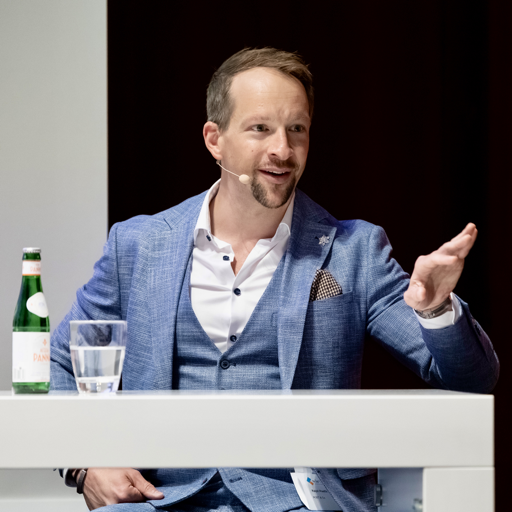
Mario Kogler co-founded JOLIOO and runs it. It is a SaaS business — an AI-powered loyalty platform for brick-and-mortar retailers, retail associations and manufacturers. He brought me in around the turn of 2023/24.
What he wanted was growth capital. What he had was a cap table with six parties on it: Mario, his technical co-founder, his commercial co-founder, a participation vehicle belonging to the company's bank, an advertising agency that had been selling its services into the company rather energetically, and one of that agency's partners.
I looked at that list before I looked at the numbers.
What nobody was naming
Everyone described this as a funding problem. It was a valuation problem, and underneath that it was a sequencing problem.
Here is what was actually happening. Without growth capital, JOLIOO could grow at a mid-double-digit rate and stay profitable — but because growth costs money, that profitability came out at roughly break-even. For a founder, that is a decent position. For three shareholders waiting for a return, it read as hopeless: no profit.
So the two sides had arrived at two different numbers for the same company, and both numbers were defensible. The founders saw the model and wanted to raise at an ambitious valuation. The other shareholders saw a business that had never distributed anything and were not willing to follow their money in — which the incoming financiers would have expected of them.
That is a deadlock, and it does not resolve by negotiation. Nobody was being unreasonable. They simply held two valuations that could not both be settled in a single transaction.
What we did
We stopped trying to agree on one price.
At the end of 2024 I structured a deal that my client Mathias Muther used to come in alongside Mario. It ran in two steps, and the order is the entire point.
Step one
Valuation before the capital
The three shareholders with the low number in mind are bought out — cheaply, with no growth capital flowing in. No fresh money, no reason for a higher price.
Step two
Valuation after the capital
Only then does Mathias inject capital, in several tranches. That raises the post-money valuation substantially — making the dilution acceptable to the founders.
For Mathias, the two steps blended into one coherent entry price. That was the trick of it.
What happened
Mathias holds the majority. The company is on a growth trajectory. And I now work with the three founders as working shareholders and with Mathias — who brings growth expertise, a network and real media presence — on preparing the largest transaction in JOLIOO's history.
What you should take from this
Two shareholders can hold two different valuations of the same company and both be right, because they are pricing two different futures. One is pricing the company with capital in it. The other is pricing the company without.
Almost every founder tries to close that gap by arguing. It does not close by arguing, because it is not a disagreement — it is arithmetic about two different companies.
It closes by sequencing: you transact with each party at the valuation that is true for the company they are actually looking at. Cheap before the money goes in. Expensive after. Same company, two steps, and the order is the whole thing.
And note the timing. Mario brought me in a year before anything happened. Not because a year of work was needed, but because the structure had to exist before anyone sat down. Structure is not something you negotiate. It is something you arrive with.

“A huge thank you to you again for handling the whole process. Fantastic!”
— Mario Kogler, Co-Founder & CEO, JOLIOO